
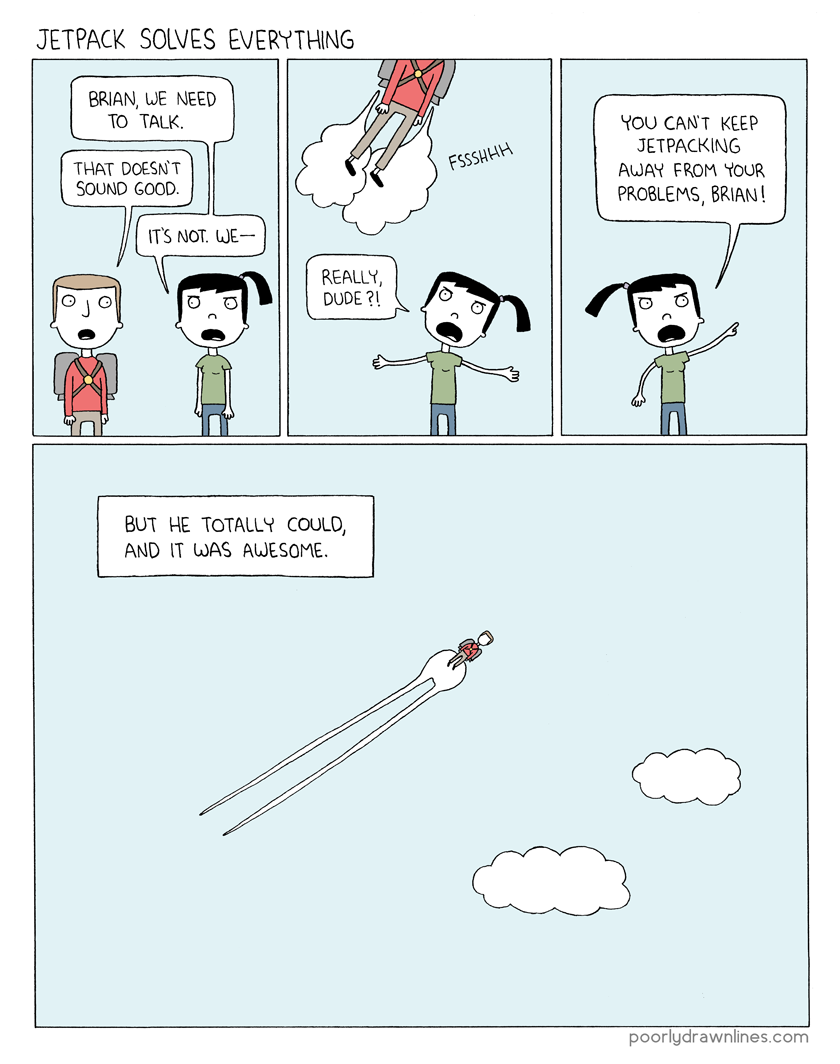
 relationship communication cartoon from poorlydrawnlines.com
The appeal of avoidance
Most of us don’t have jetpacks. But we have versions of the same move.
Suddenly becoming very busy when a difficult conversation is approaching. Picking up your phone. Agreeing with whatever your partner says just to make the tension stop. Changing the subject. Going for a drive. Having a drink. Staying late at work. Starting an argument about something unrelated so the real thing never gets addressed.
Avoidance is enormously creative. It takes many forms and most of them are socially acceptable — which makes it easy to not notice you’re doing it.
The logic underneath is simple and understandable: if I don’t engage with this, the discomfort will go away. And in the short term, it often does. The conversation doesn’t happen. The tension lifts temporarily. Brian is in the sky and it is genuinely, briefly, awesome.
The problem with jetpacking
The thing about avoided conversations is that they don’t actually go anywhere.
They sit. They accumulate. They show up in the tone of unrelated exchanges. They become the thing underneath every small irritation. And over time the weight of everything that’s been avoided makes the prospect of addressing any of it feel even more overwhelming — which makes avoidance feel even more necessary.
Psychologists call this the experiential avoidance cycle. The more we avoid something uncomfortable, the more uncomfortable it tends to feel when we do encounter it. The avoidance teaches the nervous system that the thing being avoided is genuinely dangerous — which makes the pull to avoid it stronger next time.
Brian keeps needing a faster jetpack.
Why difficult conversations feel threatening
It’s worth being honest about why avoidance is so appealing — because it’s not simply weakness or laziness. There are real reasons.
Difficult conversations carry real risks. You might say something you can’t take back. You might find out something you didn’t want to know. You might lose the relationship, or damage it, or discover that the gap between you is bigger than you thought. These aren’t irrational fears.
For some people the fear runs deeper — shaped by experiences where conflict was genuinely unsafe, where speaking up had real consequences, where the people around them couldn’t tolerate difficulty without things escalating. If that’s your history, the jetpack impulse makes complete sense. It was protective once.
The question is whether it’s still serving you now.
What staying looks like
Staying — choosing not to jetpack — doesn’t mean staying and fighting. It doesn’t mean forcing a conversation when neither person is ready for it.
It means being willing to be present with something uncomfortable rather than immediately exiting. Tolerating the tension of a difficult topic for long enough to actually engage with it. Trusting that you and the other person can survive the discomfort of an honest conversation — and that something useful might come from it.
That’s easier when you have some tools. Knowing how to call a timeout when things escalate. Knowing how to stay curious rather than defensive. Knowing that the goal isn’t to win but to understand.
It’s also easier when you’ve had some practice. Which means starting with smaller things — lower-stakes conversations that build the capacity for the harder ones.
Brian’s real problem
The comic’s joke is that the jetpack actually works — he gets away, and it’s awesome. But the joke only lands because we all know what happens next. The person who wanted to talk is still there. The conversation is still waiting. And now there’s also the matter of having dramatically jetpacked away in the middle of it.
The problems Brian is avoiding are patient. They’re not going anywhere. And the more impressive his escape, the more impossible the return.
The jetpack is a short-term solution to a long-term problem. And at some point — usually when the fuel runs out — landing is unavoidable.
If you recognise the jetpack in yourself — the pattern of avoiding difficult conversations or situations until they become impossible to ignore — this is exactly the kind of thing that individual counselling or relationship counselling can help with. Understanding what’s driving the avoidance, and building the capacity to stay, is work worth doing. Available in Squamish and online across BC.
Some ideas are worth coming back to. Once a month or so, I send a short note that looks at something familiar from a new angle.
Send me the next one
